Muscle preservation pathways are getting more attention
The peptide conversation is moving from simple weight-loss narratives toward lean-mass preservation, adherence, and long-term outcomes.
Read full analysis in appUnderstand peptides before everyone else. Compare evidence, source trails, frontier signals, and private tracker notes without living inside twenty tabs and forum threads.
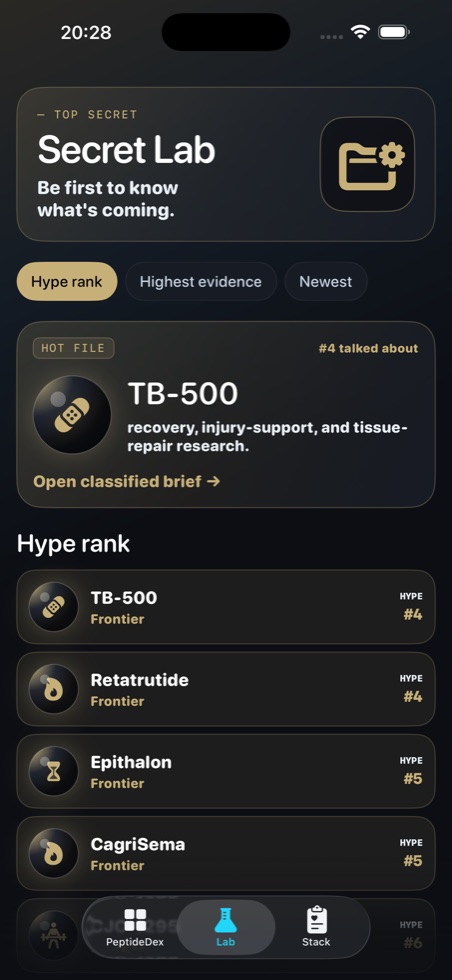
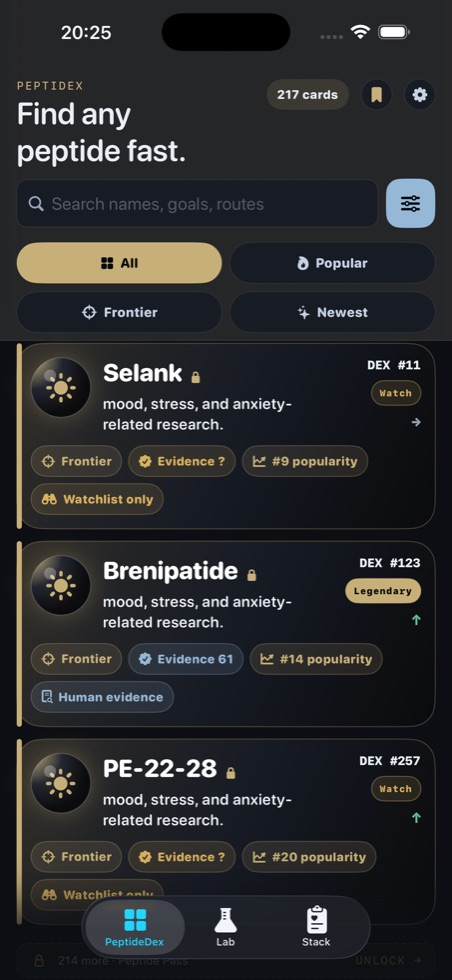
"Finally, peptide research without the noise."
The public feed gives the signal. The app gives the full analysis, source trail, ranking context, and what changed.
The peptide conversation is moving from simple weight-loss narratives toward lean-mass preservation, adherence, and long-term outcomes.
Read full analysis in appBPC-157 and TB-500 dominate search volume, but users need clearer separation between animal data, human data, and anecdotes.
Read full analysis in appMOTS-c and SS-31 sit at the intersection of metabolism, aging biology, and energy systems research.
Read full analysis in appPeople are learning that 'most talked about' and 'best supported' are not the same ranking.
Read full analysis in appHigh attention does not automatically mean strong human evidence. This is exactly where the app is useful.
You get enough context to know what matters. The deeper answer lives in the app.
The website shows a clean overview, category, and research stage. The app unlocks comparison, saved notes, tracker links, and source context.
One of the most-discussed recovery peptides online. Public interest is high, but the evidence base is still mostly animal and lab research, which makes source context essential.
Frequently compared with BPC-157 in recovery conversations, but it is a different research story with different mechanisms and evidence gaps.
A mitochondrial-derived peptide that draws attention from longevity and metabolic-health circles because it sits close to energy regulation research.
Also known as elamipretide, SS-31 is commonly discussed in mitochondrial medicine and aging biology because it targets cellular energy systems.
A GLP-1 receptor agonist with a large human evidence base and massive public attention in metabolic-health and weight-management discussions.
A high-attention investigational multi-agonist in metabolic research. It attracts interest because it sits at the frontier of incretin science.
A growth-hormone-releasing hormone analog with a more established clinical context than many peptides discussed online.
A copper peptide commonly discussed around skin, hair, and wound-healing research, with broad consumer interest and varied evidence quality.
A longevity-associated peptide with persistent online interest and a complicated research story that deserves careful source review.
A frequently searched pairing in growth-hormone secretagogue conversations, often mentioned by clinics and optimization communities.
Recovery, muscle, metabolic health, sleep, cognition, skin, and longevity all connect to different evidence maps. The app keeps them separate.
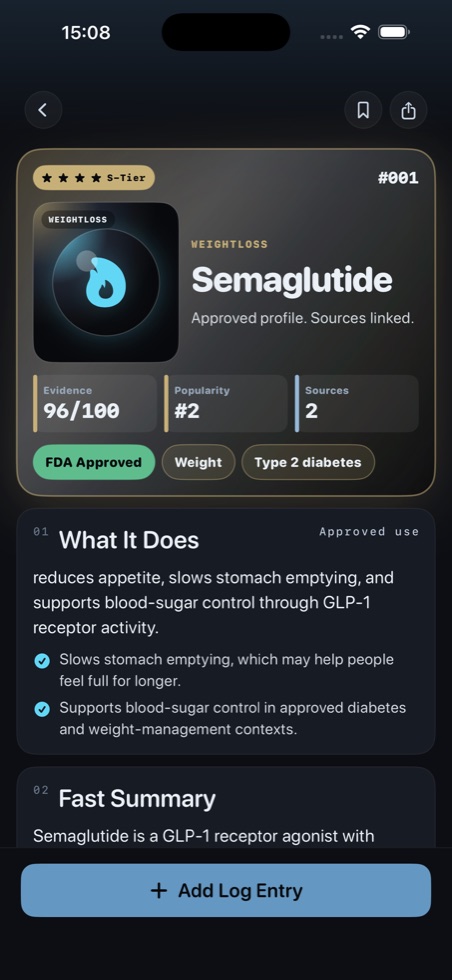
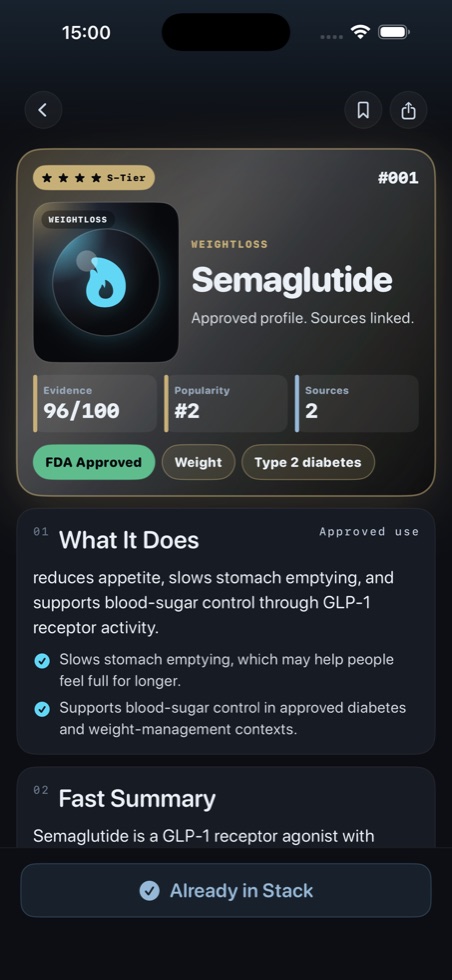

Public pages reveal titles, plain-English summaries, and research categories. Expert interpretation, ranking context, and tracker actions stay app-exclusive.
One of the most-discussed recovery peptides online. Public interest is high, but the evidence base is still mostly animal and lab research, which makes source context essential.
Open public briefFrequently compared with BPC-157 in recovery conversations, but it is a different research story with different mechanisms and evidence gaps.
Open public briefA mitochondrial-derived peptide that draws attention from longevity and metabolic-health circles because it sits close to energy regulation research.
Open public briefAlso known as elamipretide, SS-31 is commonly discussed in mitochondrial medicine and aging biology because it targets cellular energy systems.
Open public briefA GLP-1 receptor agonist with a large human evidence base and massive public attention in metabolic-health and weight-management discussions.
Open public briefA high-attention investigational multi-agonist in metabolic research. It attracts interest because it sits at the frontier of incretin science.
Open public briefEach pathway is framed as education and organization. The app helps you compare, save, and track user-entered plans.
Start with injury context, evidence quality, and source type.
Compare metabolic entries by approval status and evidence depth.
Organize mitochondrial, senolytic, and repair-related claims.
Keep hype, regulatory status, and human evidence separate.
Quick public comparison. Full app matrix with evidence, category, stage, source quality, and saved notes.
Two recovery favorites, two very different research maps.
Mitochondrial signaling versus mitochondrial membrane targeting.
Often discussed together, but not the same mechanism story.
Approved GLP-1 evidence versus investigational multi-agonist attention.
Stop re-reading the same forum threads and start from organized evidence context.
Each card separates mechanism, evidence, attention, stage, and source quality.
Hype rank and evidence rank are deliberately kept apart.
Save entries, watch emerging compounds, and keep private notes in one place.
A weekly signal brief for new research, rising peptide searches, evidence shifts, and what to open inside the app.